Random Color Palette Generator: When Randomization Actually Helps Design
Discover when and how to use random color palette generators effectively. Learn why controlled randomization beats manual picking for certain design tasks, and how tools like Colorhero use smart randomization to generate harmonious palettes instantly.
Random color palette generators sound counterintuitive. Design is supposed to be intentional, methodical, and strategic. Why would anyone leave color choices to chance? The answer lies in understanding when randomization helps and when it hurts. Used correctly, random generation breaks creative blocks, reveals unexpected combinations, and dramatically speeds up the exploration phase of design work.
The key distinction is between truly random chaos and curated randomization. The best palette generators do not just pick arbitrary hex values. They apply color theory rules, harmony principles, and contrast requirements while randomizing within those constraints. This guide explains when random generation makes sense, how to use it effectively, and why it has become an essential part of modern design workflows.
Why Random Palette Generation Works
Human designers tend toward safe, familiar choices. We pick the same blues, the same neutrals, the same combinations we have seen work before. This makes sense for client work with tight deadlines, but it limits creative exploration and leads to generic-looking results. Random generation forces exposure to combinations you would never consciously choose.
- Breaks habitual color picking patterns that limit creativity
- Surfaces unexpected combinations that human intuition misses
- Speeds up exploration when starting from zero
- Reduces decision fatigue during early design phases
- Generates options faster than manual experimentation
The psychology behind this is well-documented in creative research. Constraints and randomness together produce more innovative results than unlimited freedom. When you cannot predict what comes next, you evaluate each result on its merits rather than comparing it to preconceptions.
When to Use Random Palette Generators
Random generation is not appropriate for every situation. Understanding when it helps versus when manual selection is better prevents wasted effort and ensures you use the right approach for each project phase.
Early exploration and brainstorming
The beginning of any design project involves exploring possibilities before committing to a direction. This is where random generation shines brightest. Generate dozens of palettes in minutes, screenshot the ones that spark interest, and use them as starting points for refinement.
Breaking creative blocks
When you have been staring at the same design for hours and nothing feels right, random generation provides fresh perspectives. Sometimes the solution is a color combination you would never have considered consciously. One click generates a completely different direction to evaluate.
Personal projects without brand constraints
Side projects, portfolios, and experiments benefit enormously from random exploration. Without client guidelines or brand requirements, you have freedom to discover unexpected directions. Random generation maximizes that creative freedom.
Learning color relationships
Designers developing their color intuition can learn rapidly by studying randomly generated palettes. Each generation shows a new combination that works, building visual vocabulary and pattern recognition over time. It is like flash cards for color harmony.
Generate random palettes in Colorhero →
When NOT to Use Random Generation
Random generation has clear limitations. Knowing when to avoid it saves time and produces better outcomes for certain project types.
Established brand projects
When working with existing brand guidelines, random generation is inappropriate. The colors are already defined. Your job is application and extension, not exploration. Use random generation only if explicitly asked to propose a rebrand.
Industry-specific requirements
Some industries have strong color conventions. Healthcare uses blues and greens for trust. Finance uses navy and burgundy for authority. Random generation might suggest combinations that violate audience expectations and harm credibility.
Final refinement stages
Once you have committed to a direction, random generation no longer helps. Final polish requires intentional, incremental adjustments. Switching to entirely new palettes at this stage wastes work and delays completion.
How Smart Random Generators Work
Not all random palette generators are equal. The difference between useful tools and useless chaos comes down to the constraints applied during generation. Smart generators like Colorhero randomize within color theory rules rather than picking arbitrary values.
Harmony rules enforcement
Quality generators ensure randomly selected colors have harmonic relationships. Complementary, analogous, triadic, or split-complementary combinations all have mathematical relationships that create visual coherence. Random selection within these frameworks produces usable results.
- Colors are selected from harmonic relationships, not arbitrary positions
- Saturation and lightness are balanced across the palette
- Temperature consistency is maintained within each generation
- Accent colors have sufficient contrast against backgrounds
Contrast verification
Every generated palette must pass accessibility contrast checks. Text colors need sufficient contrast against backgrounds. Accent colors need visibility against their contexts. Smart generators verify these requirements automatically before showing results.
Role-based structure
The best generators assign roles to each color rather than just generating a strip of swatches. Background, accent, text, and secondary text each serve specific purposes. Random generation within this structure produces immediately usable systems rather than decoration.
How Colorhero Generates Perfect Hero Section Palettes →
Using Random Generation Effectively
Getting value from random generation requires the right workflow. These practices maximize the benefits while avoiding common pitfalls.
Generate in batches
Do not evaluate each palette individually as it appears. Generate ten or twenty palettes rapidly, screenshot or save each one, then review them as a collection. Patterns emerge, preferences clarify, and the best options become obvious when compared side by side.
Use the lock feature
Most quality generators let you lock certain colors while randomizing others. Found a perfect background but need a better accent? Lock the background and keep generating. This constrained randomization converges on ideal combinations faster than starting fresh each time.
Test in context immediately
A palette that looks good in a generator might fail in your actual design. Copy hex codes into your project and see how colors perform with real content, real typography, and real layouts. Context reveals problems that swatches hide.
Trust your gut reactions
When a randomly generated palette immediately feels right, trust that instinct. Your visual intuition processes harmony faster than conscious analysis. If something clicks instantly, explore that direction before moving on.
Common Random Generation Mistakes
Even with good tools, designers make predictable mistakes when using random generators. Avoiding these errors improves results significantly.
Infinite generation loops
The perfect palette does not exist. If you have generated fifty options and none feel right, the problem is not the tool. Either your criteria are unclear, or you are waiting for a feeling that will never come. Set a limit, pick the best from what you have, and refine manually.
Ignoring project constraints
Random generation should still respect project realities. If your client hates orange, generating palettes with orange accents wastes time. Use mode filters and color preferences to eliminate inappropriate options from the start.
Skipping contrast verification
Not all generators check accessibility automatically. Before committing to any palette, verify contrast ratios meet WCAG standards. A beautiful palette that fails accessibility requirements is not usable.
Random Generation for Different Project Types
Different projects benefit from different random generation approaches. Matching the technique to the project type produces better results faster.
Landing pages and hero sections
Hero sections need bold, clear palettes with strong contrast between background, text, and call to action. Random generation works excellently here because the requirements are consistent: readable text, visible button, cohesive feeling. Colorhero specializes in exactly this use case.
Hero Section Color Ideas That Make Your Site Pop →
Social media graphics
Social content needs to stand out in crowded feeds. Random generation often produces bolder combinations than designers would choose manually. The unexpected can become attention-grabbing rather than off-putting in social contexts.
Data visualization
Charts and graphs need distinguishable colors that remain accessible to colorblind users. Random generation with proper constraints can produce unique visualization palettes that differentiate data series effectively.
Colorhero Random Generation Approach
Colorhero takes a specific approach to random palette generation designed for hero sections and landing pages. Understanding how it works helps you use it more effectively.
Curated palette library
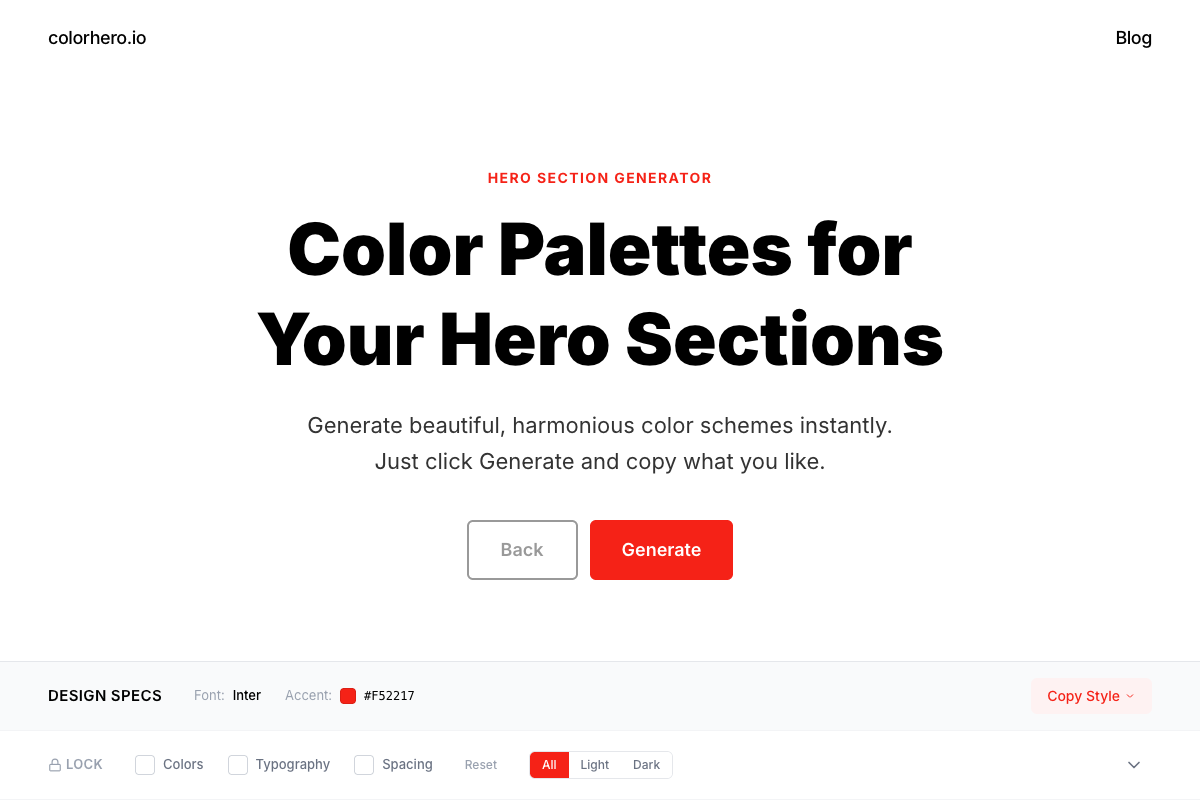
Rather than generating mathematically random colors, Colorhero selects from a library of professionally curated palettes. Each palette in the library has been designed to work for hero sections specifically, with proper contrast ratios and role assignments already verified.
- Over 280 curated palettes covering light, dark, warm, and gradient styles
- Each palette pre-verified for accessibility and contrast
- All palettes include background, accent, text, and light text roles
- One-click generation with optional locking of preferred colors
Mode filtering
Colorhero lets you filter random generation by mode: light backgrounds, dark backgrounds, or all options. This constrained randomization matches generation to project requirements while maintaining the benefits of unexpected discovery.
Lock and generate
When you find colors you want to keep, lock them. Colorhero then randomizes only the unlocked elements. Found the perfect background but need a different accent? Lock the background and generate until the accent clicks. This workflow converges on ideal combinations efficiently.
Try random generation in Colorhero →
FAQ
Is random color generation actually random?
In quality tools like Colorhero, generation is randomized but constrained. Colors are selected randomly from curated options that already meet harmony, contrast, and accessibility requirements. This produces usable results while maintaining the benefits of unexpected discovery.
How many palettes should I generate before choosing?
Generate ten to twenty palettes in a batch, save the ones that interest you, then compare them in context. If nothing works after fifty generations, reconsider your criteria rather than continuing to generate. The perfect palette does not exist, but good enough does.
Can I use random generation for client work?
For early exploration and presenting options, absolutely. Generate multiple directions to show clients during discovery phases. However, final deliverables should be refined intentionally rather than left to randomization. Use random generation to find starting points, not endpoints.
Why do some random palettes look bad?
Basic random generators that select arbitrary hex values produce unusable results because they ignore color theory. Quality generators like Colorhero constrain randomization to harmonious relationships and verified contrast ratios, ensuring every result is at least usable.
Should beginners use random generation?
Yes. Random generation is excellent for learning. Each generated palette demonstrates a working color relationship. Studying why certain combinations work builds intuition faster than manual experimentation. Generate, analyze, and learn from each result.
Start Generating
Random palette generation is a powerful tool when used correctly. It breaks creative blocks, speeds up exploration, and reveals combinations you would never discover manually. The key is using constrained randomization within color theory rules, not pure chaos.
Generate your first random palette with Colorhero →
The Best Color Palette Generators Compared →
How to Build a Brand Color System in One Hour →
The Psychology of Website Colors →
Try Colorhero
Colorhero generates complete hero section palettes with one click. Our curated library of 280+ palettes ensures every random generation produces harmonious, accessible color combinations ready for your landing pages. Lock your favorites and keep generating until the perfect combination appears.